
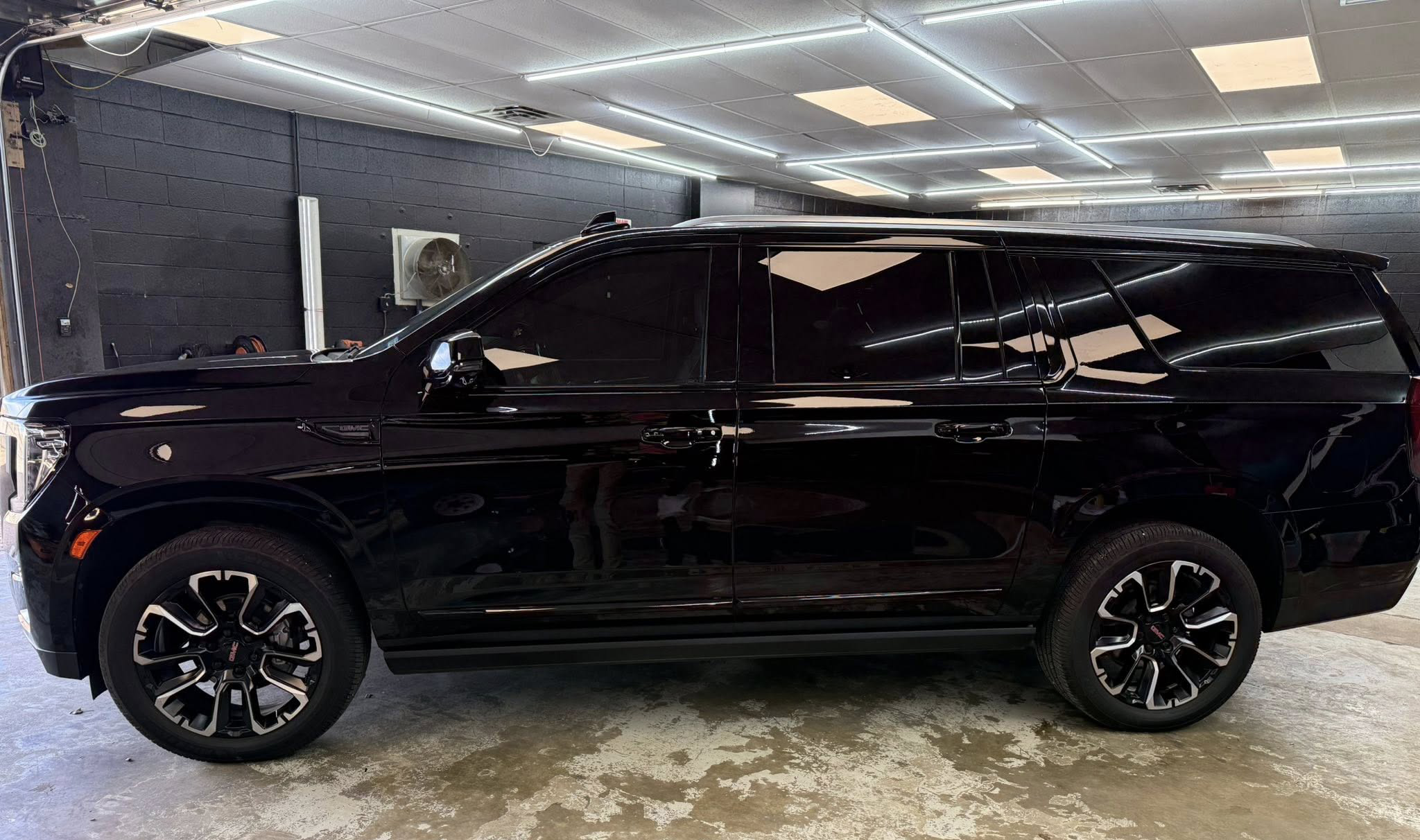
Before you get your windows tinted in Texas, you need to understand the rules. Texas has specific regulations about how dark your tint can be, which windows can be tinted, and what happens if you fall outside the legal limits. Getting it wrong can mean a citation, a fine, or the hassle of having your tint removed and redone.
Here is a straightforward breakdown of Texas window tint laws as of September 15, 2026 — what is legal, what is not, and how to make informed decisions about your window tint installation.
Texas Window Tint Regulations
Texas tint laws are measured by Visible Light Transmission (VLT) — the percentage of visible light that passes through the film. A lower VLT number means darker tint. Here is what Texas law allows:
Front Windshield
You may only tint the top portion of your front windshield. Tint is allowed above the AS-1 line, a line marked on most windshields by the manufacturer. If your windshield has no AS-1 line, the film must end five inches below the top of the glass. This strip is commonly called the visor strip or sun strip. The strip must allow 25% or more VLT and cannot be red, amber, or blue in color. The rest of the windshield must remain clear.
However, you can apply a clear or nearly clear ceramic film across the full windshield that blocks UV and infrared heat without significantly reducing visible light. This is a popular option for Amarillo drivers looking for heat rejection without changing the windshield’s appearance.
Front Side Windows
Front side windows (the driver and front passenger windows) must allow 25% or more of visible light through. Exactly 25% is legal. Below that is not. In practice, many professional installers recommend targeting 30-35% VLT to build in a safety margin, since factory glass already blocks some light (typically 70-80% VLT), and the combined total of factory glass plus film is what gets measured.
Rear Side Windows
Texas places no VLT restriction on rear side windows for passenger vehicles. You can go as dark as you want, including full limo tint (5% VLT), on the rear doors.
Rear Window
Like the rear side windows, the back windshield has no darkness restriction for passenger vehicles. You can tint it as dark as you like. If you do tint the rear window dark enough to limit rearward visibility, Texas law requires your vehicle to have side mirrors on both sides — which virtually all modern vehicles already have.
Reflectivity
Texas law prohibits tint that is more than 25% reflective on any window. This rules out certain metallic or mirror-finish films that were more common in the past but are still available from some suppliers.
SUVs and Trucks vs. Sedans
Texas treats multi-purpose vehicles (SUVs, vans, trucks with extended cabs) the same as passenger cars for front windshield and front side window regulations. The 25% VLT minimum applies to the front side windows regardless of vehicle type. Rear windows on all passenger vehicles have no restriction.
Medical Exemptions
Texas does allow medical exemptions for darker front window tint. If you have a medical condition that requires additional protection from sunlight — such as lupus, photosensitivity, or certain skin conditions — you can apply for an exemption through your physician.
The exemption requires a signed statement from a licensed physician or licensed optometrist demonstrating that the tinting is necessary to safeguard the health of the driver or occupant. You must keep this documentation in the vehicle and present it if you are stopped.
What Happens If Your Tint Is Too Dark?
Illegal window tint in Texas is a Class C misdemeanor. Here is what you can expect:
- Traffic citation: Officers can pull you over specifically for tint that appears to violate the law. They use VLT meters to measure your tint on the spot.
- Fine: A Class C misdemeanor carries a maximum fine of $500. First offenses are commonly assessed in the $20 to $275 range plus court costs, though amounts vary by jurisdiction.
- Correcting the violation: Some courts will dismiss the citation if you remove or replace the non-compliant film and show proof that the problem was fixed.
- Repeat offenses: Multiple violations can result in increasing fines.
Texas ended its annual safety inspection requirement for non-commercial vehicles on January 1, 2025, so tint is no longer checked during a yearly inspection. Drivers now pay an inspection program replacement fee at registration instead, and emissions testing applies only in designated counties, which do not include Potter or Randall.
That makes enforcement a traffic stop issue rather than a scheduled one. Non-compliant tint can go unnoticed for years and then cost you on a single stop, along with the expense of having film stripped and reinstalled. Getting it right the first time, at the correct darkness with professional measurement, avoids both.
Choosing the Right Tint Level for Your Vehicle
Understanding the law is the first step. The next is choosing the right film for your driving needs and the Panhandle climate.
Ceramic Film vs. Dyed Film
Not all window films are created equal. The type of film matters as much as the darkness level:
Dyed film is the most affordable option. It provides privacy and some heat reduction but fades over time and offers limited infrared rejection. Under the intense Amarillo sun, dyed films tend to turn purple and degrade faster than in milder climates.
Carbon film offers better heat rejection and UV blocking than dyed film, with a matte appearance that does not fade to purple. It is a solid mid-range choice.
Ceramic film is the highest-performing option. It rejects a significant percentage of solar heat and blocks UV rays while maintaining optical clarity — even at lighter VLT levels. For Panhandle summers where interior temperatures in a parked vehicle can exceed 150 degrees, ceramic tint makes a meaningful difference in comfort and interior protection.
Ceramic film also pairs well with ceramic coating on the exterior — both products use advanced ceramic technology to protect different parts of your vehicle from the same harsh conditions.
Balancing Darkness and Visibility
At the legal limit on the front windows (25% VLT), you get solid heat rejection, UV protection, and a clean appearance. Many drivers go with 25% on the front sides and a darker shade — 15% or even 5% — on the rear windows for maximum privacy and heat reduction in the back of the vehicle.
The right combination depends on your priorities. If you drive frequently at night or in low-light conditions, a slightly lighter front tint may be more comfortable. If maximum heat rejection is the goal, going as dark as legally allowed on every window makes sense.
Why Professional Installation Matters
Texas law makes it your responsibility to ensure your tint is legal. A professional installer measures your existing glass light transmission before applying film, because factory glass is not perfectly clear — it already blocks some light. If your factory glass transmits 78% of light and you add a film rated at 30%, your combined VLT is roughly 23% — which is below the legal limit.
A professional shop accounts for this. We measure the combined VLT of glass plus film to ensure your vehicle stays compliant while getting you the performance and appearance you want.
Get Your Windows Tinted Right
If you are in Amarillo or the surrounding Texas Panhandle and want professional window tint that meets Texas law and performs in this climate, give us a call at (806) 680-6466 or request a free estimate. We will help you choose the right film type and darkness level for your vehicle, your driving habits, and your budget — and make sure everything is installed to last.